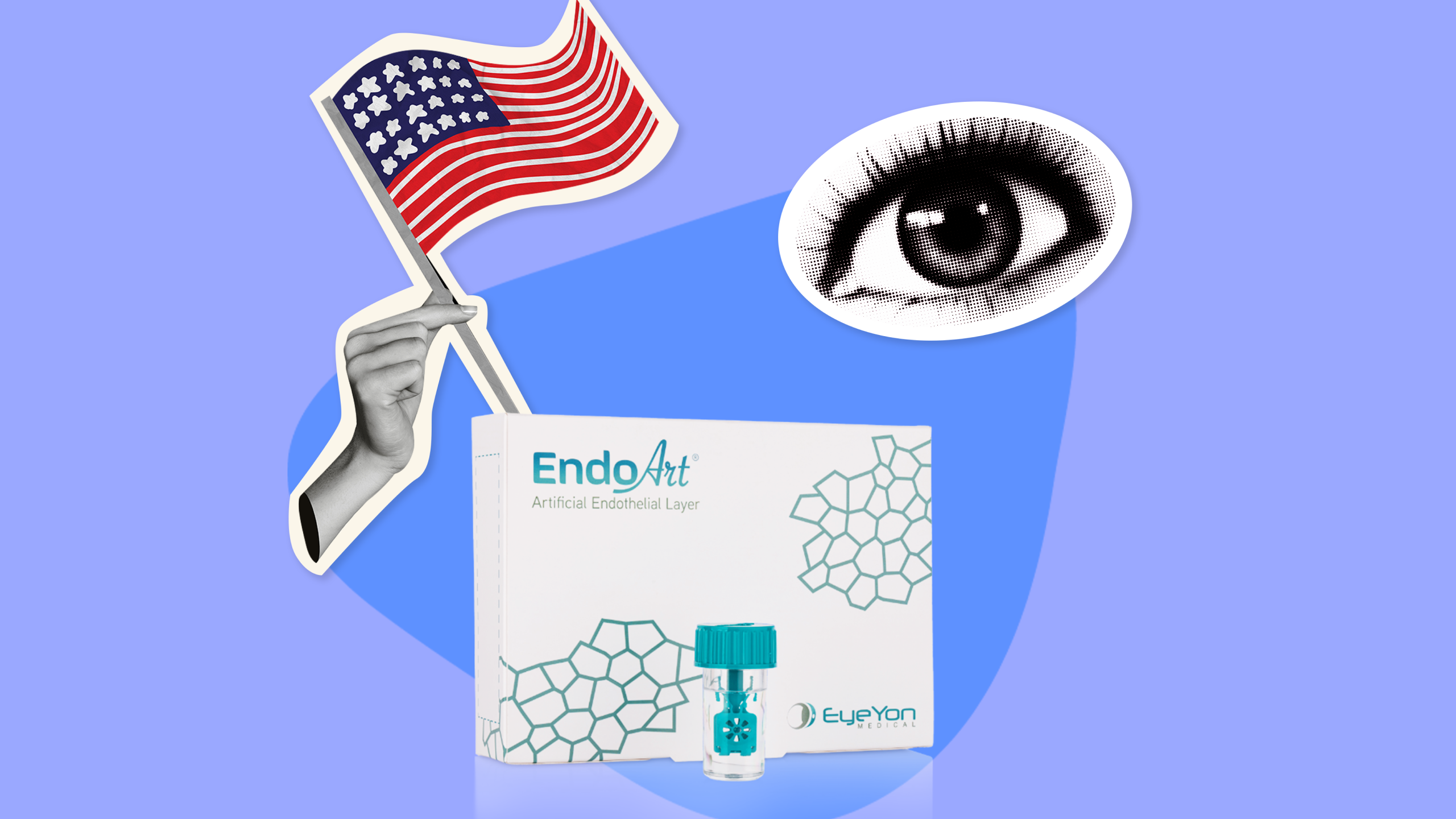
A synthetic sliver that could upend corneal edema care in the U.S.—no donor required.
EndoArt (EyeYon Medical; Ness Ziona, Israel) has received Investigational Device Exemption (IDE) from the U.S. Food and Drug Administration (FDA) to begin its first U.S. clinical study. The implant is the world’s first synthetic endothelium layer for chronic corneal edema and also holds the FDA’s Breakthrough Device Designation.
Prof. Dr. Francis Mah, director of Cornea and External Disease at Scripps Clinic Medical Group, will lead the study alongside ten U.S. cornea surgeons at surgical centers worldwide.
“The initiation of this U.S. clinical study marks an exciting moment for our field. EndoArt represents a truly novel approach to treating chronic corneal edema,” said Prof. Mah. “I’m honored to lead this important investigation and to help evaluate a technology that may reshape the future of endothelial disease management.”
What is EndoArt?
EndoArt is the first synthetic implant designed specifically for chronic corneal edema. It restores function and improves vision by offering a donor-independent option—something many clinicians have been waiting for as donor availability continues to fluctuate.
The implant attaches to the posterior corneal surface to block fluid entry and prevent the buildup of edema. The procedure is minimally invasive, protects fragile ocular tissue and is designed to deliver a high rate of successful implantation.
READ MORE: EndoArt® in Action at ESCRS 2025
Why it matters
The IDE green light opens the door to a new pathway for patients who are not suitable candidates for traditional transplant surgery. A predictable, synthetic implant removes uncertainty tied to donor tissue variability and rejection risk. For corneal specialists, this could mark a meaningful shift in how endothelial disease is managed and widen the therapeutic window for patients whose options have historically been limited.
“Securing FDA IDE approval marks a pivotal milestone for EyeYon Medical and for patients suffering from corneal endothelial diseases, a market that exceeds $1B globally,” said Nahum Ferera, CEO of EyeYon Medical. “EndoArt® has shown rapid adoption in Europe, and this study brings us one step closer to delivering a new hope for patients who are not reasonable candidates for human tissue implantation in the U.S.”
READ MORE: ESCRS Guidelines Set New Global Standard for Cataract and Refractive Surgery
The global corneal endothelial disease market is valued at over $1 billion, and a scalable, donor-independent solution could begin addressing longstanding gaps in both access and availability.
Global experience of EndoArt
Even before entering the U.S. regulatory pathway, EndoArt had accumulated a broad base of clinical use. Adoption has continued to grow across Europe, where surgeon confidence and familiarity are on the rise. A dedicated clinical trial in China has also progressed successfully, adding to the evidence base with diverse patient populations.
To date, more than 800 EndoArt implantations have been performed worldwide, while clinical follow-up of up to seven years demonstrates sustained corneal clarity, stability and durable therapeutic benefit.
READ MORE: AAO 2025 Novel Corneal Treatment Symposium Charts Path from Bench to Clinic
Takeaway
As EndoArt embarks on its first U.S. clinical study, the field edges closer to a future where treating corneal edema may no longer depend on donor tissue at all. The solution might instead arrive neatly packaged, predictable and ready off the shelf. Corneal specialists, consider this your cue to get excited—there may soon be a new layer to work with.
Editor’s Note: This content is intended exclusively for healthcare professionals. It is not intended for the general public. Products or therapies discussed may not be registered or approved in all jurisdictions, including Singapore.